
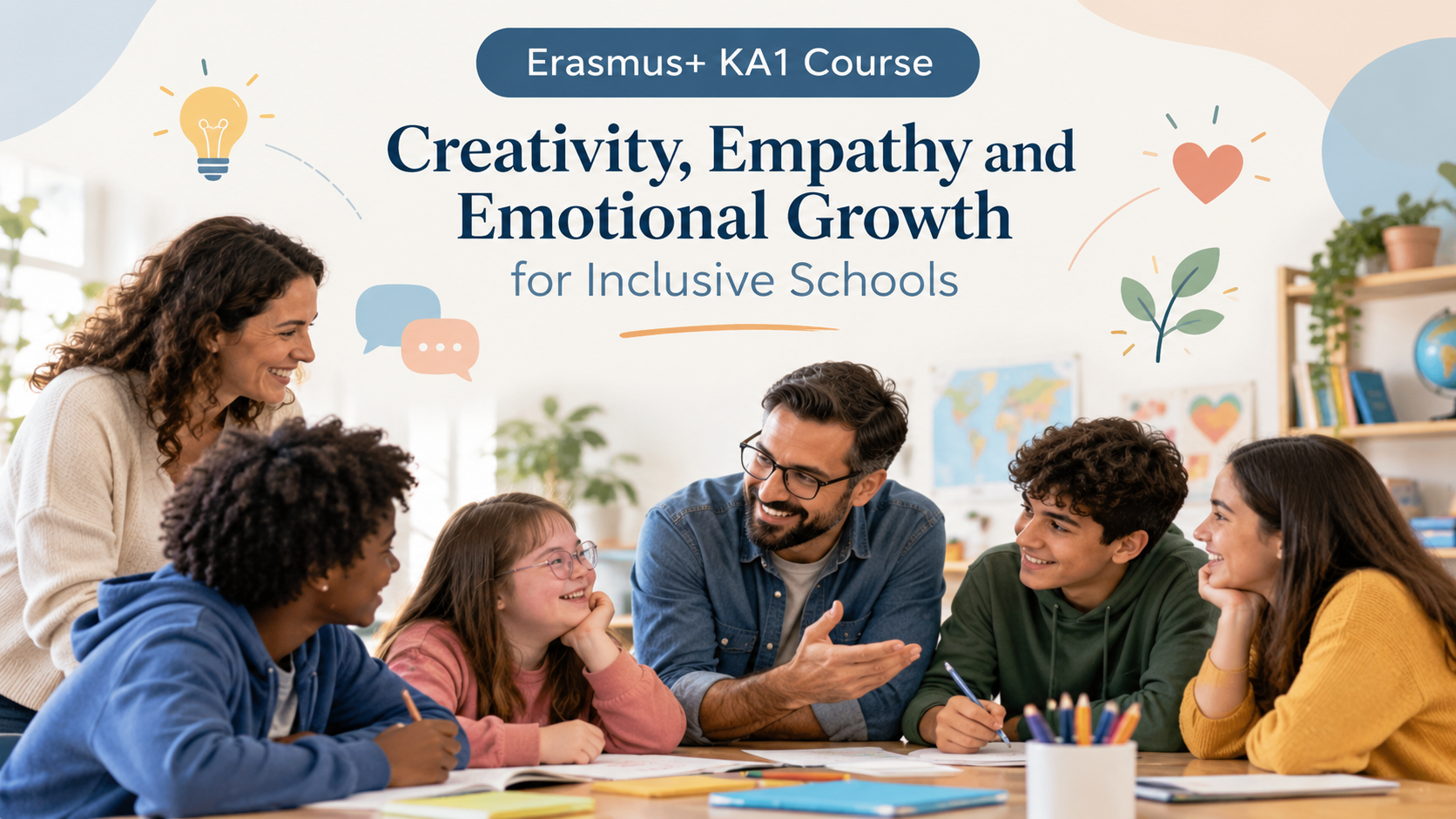
Creativity, Empathy and Emotional Growth for Inclusive Schools
This five-day Erasmus+ KA1 course supports teachers, school leaders and education professionals in creating inclusive learning environments through creativity, empathy and socio-emotional development. The course explores how emotional awareness, perspective-taking, creative expression and inclusive classroom practices can strengthen participation, belonging and well-being for all students. Participants experience practical methods that can be adapted to different age groups, learning needs and school contexts, with particular attention to students who may face social, emotional, cultural or learning barriers. Through experiential activities, reflection, collaborative design and practical planning, participants develop strategies to build safer, more supportive and emotionally responsive schools.
Course Description
This five-day Erasmus+ KA1 course supports teachers, school leaders and education professionals in creating inclusive learning environments through creativity, empathy and socio-emotional development. The course explores how emotional awareness, perspective-taking, creative expression and inclusive classroom practices can strengthen participation, belonging and well-being for all students. Participants experience practical methods that can be adapted to different age groups, learning needs and school contexts, with particular attention to students who may face social, emotional, cultural or learning barriers. Through experiential activities, reflection, collaborative design and practical planning, participants develop strategies to build safer, more supportive and emotionally responsive schools.
Methodologies Of The Course
- Experiential and non-formal learning activities
- Creative drama, storytelling, visual expression and reflective practice
- Empathy-building and perspective-taking exercises
- Cooperative learning and peer exchange
- Case-based analysis of inclusive classroom situations
- Social and emotional learning activities
- Universal Design for Learning-inspired adaptation of activities
- Group work, micro-practice, feedback and action planning
By the end of the course, participants will be able to:
- explain the role of empathy, emotional awareness and creativity in inclusive education;
- recognise emotional, social and participation barriers that may affect students;
- apply practical empathy-building and socio-emotional learning activities in school settings;
- use creative methods to support communication, self-expression and student voice;
- adapt classroom activities for diverse abilities, backgrounds and learning needs;
- strengthen positive relationships, cooperation and a sense of belonging;
- respond more constructively to challenging emotions, conflict and exclusion;
- design an inclusive classroom or whole-school action plan that can be implemented after the mobility.
Available Dates & Locations
5-Day Training Programme
Understanding Inclusion, Emotions and Belonging
Topics
- Welcome, introductions and course expectations
- Inclusion as participation, belonging and equal opportunity
- Understanding emotional safety in learning environments
- Basic principles of social and emotional learning
- Recognising barriers to participation and belonging
- The role of teacher attitudes, relationships and classroom climate
Tasks
- Participate in creative ice-breaking and trust-building activities.
- Map factors that help students feel included or excluded.
- Analyse short classroom scenarios involving emotional and participation barriers.
- Complete an “emotional climate” reflection for your own school context.
- Identify one priority area for improving student belonging.
Empathy, Perspective-Taking and Positive Relationships
Topics
- What empathy is and how it differs from sympathy
- Perspective-taking and active listening
- Emotional literacy and recognising different viewpoints
- Communication that validates students without lowering expectations
- Building trust and respectful teacher–student relationships
- Peer empathy and cooperative classroom culture
Tasks
- Practise active listening in pairs using structured prompts.
- Complete perspective-taking exercises based on diverse student profiles.
- Use empathy maps to explore what a student may see, feel, need and experience.
- Role-play teacher responses to emotionally challenging situations.
- Design a short empathy-building activity for students.
Creativity and Emotional Expression in Inclusive Classrooms
Topics
- Creativity as a tool for participation and self-expression
- Storytelling and creative drama for emotional exploration
- Visual and multimodal expression for students with different communication preferences
- Low-risk creative activities that encourage student voice
- Supporting confidence, imagination and collaboration
- Adapting creative activities for diverse needs and abilities
Tasks
- Take part in a short creative drama and storytelling sequence.
- Explore emotion cards, visual prompts and non-verbal expression techniques.
- Redesign a conventional classroom activity using a creative and inclusive approach.
- Work in groups to adapt one activity for students with different participation needs.
- Prepare and demonstrate a short creative emotional-learning activity.
Managing Emotions, Conflict and Inclusive Participation
Topics
- Emotional regulation in classroom situations
- Understanding triggers, escalation and de-escalation
- Constructive responses to conflict and exclusion
- Restorative and solution-focused communication
- Creating psychologically safer group routines
- Supporting participation without forcing disclosure or performance
Tasks
- Analyse conflict and exclusion scenarios from school life.
- Practise simple grounding and emotional regulation techniques suitable for classroom use.
- Transform punitive or reactive responses into restorative alternatives.
- Develop inclusive participation routines for group work and discussion.
- Create a practical “response toolbox” for emotionally difficult classroom moments.
Designing an Inclusive and Emotionally Supportive School Practice
Topics
- From individual activities to sustainable school practice
- Integrating empathy and creativity into everyday teaching
- Inclusive classroom routines and student participation
- Teacher well-being, boundaries and reflective practice
- Transfer of learning to participants’ schools
- Evaluation, peer feedback and sustainability
Tasks
- Review and select methods most relevant to your own professional context.
- Design an individual or institutional action plan for implementation after the course.
- Present a practical inclusive activity or strategy developed during the week.
- Give and receive structured peer feedback.
- Complete final reflection, evaluation and transfer planning.
Objectives of the Mobility Experience
The mobility experience aims to:
- strengthen participants’ capacity to create emotionally safe, inclusive and participatory learning environments;
- develop practical skills in empathy, emotional literacy, creative expression and relationship-building;
- equip participants with adaptable methods for supporting diverse students and reducing barriers to participation;
- promote positive classroom climate, cooperation, student voice and a stronger sense of belonging;
- encourage reflective teaching and sustainable transfer of inclusive socio-emotional practices to participants’ schools;
- support European exchange of experiences, methods and perspectives on inclusive education.
Type of Certification Awarded
Register for This Course
Please complete the form below to register or request more information.